
1. Direct Answer: Balancing Fixed Pairs in Open Play
A Fixed Pair (or Locked Doubles) setting allows two players to remain permanent partners across an entire open play session while rotating against different opponents each round.
Basic greedy queue apps fail with fixed pairs because they cause 45-minute bench deadlocks or line-cutting accusations. PickleLobby resolves this using lookahead combinatorial scheduling that buffers and matches fixed pairs against available opponent pairs without stalling court turnover.
2. The Real Courtside Dilemma: Competitive Couples and Tournament Teams
Every pickleball organizer encounters this scenario on busy club nights: two players arrive together, such as a competitive doubles duo training for an upcoming tournament or a couple arriving together requesting to play together all night.
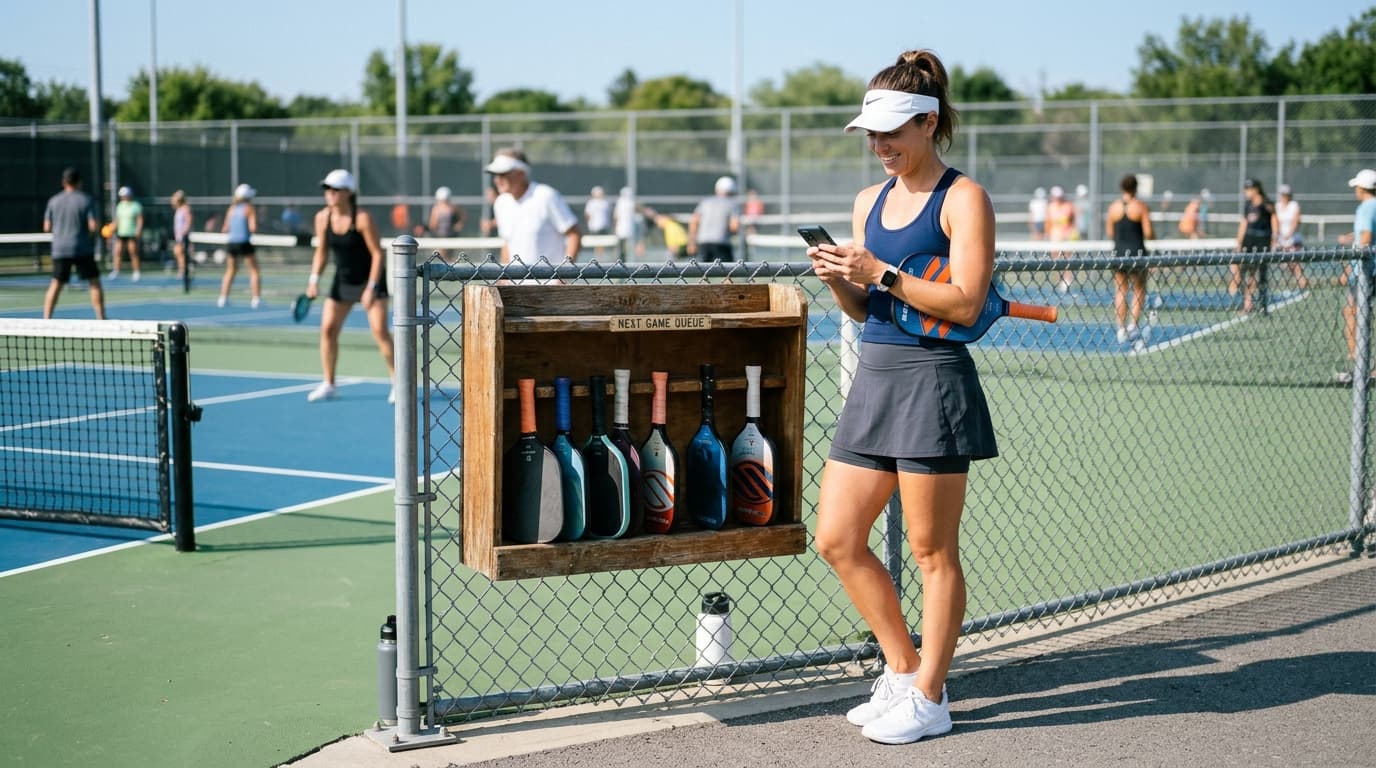
When hosts use traditional dry-erase whiteboards or magnetic paddle racks, this request creates immediate organizational friction:
- The rigid refusal: The host responds with 'No, this is open play; everyone shuffles.' The pair leaves dissatisfied, reducing club revenue.
- The manual host workaround: The host attempts to track the pair manually. Within three rounds, the host loses track of rest intervals and faces accusations of favoritism from waiting solo players.
- The partner desync: If one partner plays a 14-minute grind while the other finishes a 6-minute blowout on another court, their rest cycles fall completely out of sync.
3. Why Basic Queue Apps Break Down: The Mathematical Deadlock
Primitive pickleball session apps treat all participants as independent, identical queue tokens. When fixed pairs are introduced into these naive engines, three distinct systemic failures occur:
Failure 1: The 45-Minute Bench Freeze
In a naive single-player FIFO queue, when Partner A reaches the top, they cannot take the court until Partner B also climbs to the top.
If another match finishes first, the system holds Partner A in limbo, resulting in 35 to 45-minute bench waits while other players cycle onto courts multiple times.
Greedy single-entry queues fail because they evaluate players as isolated tokens rather than coupled units.
Failure 2: The Line-Cutting Dilemma
If the app artificially pulls Partner B ahead of waiting solo players to pair them with Partner A, solo players waiting in line rightfully complain about queue jumping.
Failure 3: The Court Lockout Trap
In small venues (e.g. 2 courts with 12 to 16 players), primitive engines frequently lock an entire court waiting for another fixed pair to finish, stalling facility throughput.
4. The PickleLobby Solution: Lookahead Combinatorial Scheduling
PickleLobby solves the fixed-pair challenge through lookahead combinatorial scheduling. Instead of treating players as isolated queue tokens, the engine separates Player Rest Tiers from Match Composition.
When a court becomes available, PickleLobby evaluates candidate 4-player match permutations against a multi-variable cost function that weighs rest variance, previous opponent history, and skill balance.
Once a fixed pair completes Match 1 together, their rest timestamps remain synchronized, allowing the lookahead buffer to insert them into the next viable 4-player slot without violating individual rest caps.
The Partner-Split Exemption and Win Streak Caps
In progressive formats like Winners vs. Losers, traditional rules require winning partners to split across the net in their next game.
For Fixed Pairs, PickleLobby applies a Pair-Preservation Override: the winning pair moves up to the next court intact, while the opposing court provides two new opponents.
To prevent elite fixed pairs from camping on Court 1 all night, PickleLobby enforces an automatic Win Streak Cap (default: 2 consecutive wins). Once the cap is reached, the pair rotates cleanly to the rest queue.
Win streak caps prevent court stagnation and guarantee every player a fair shot at the championship court.
5. Host Playbook: Best Practices for Running Fixed Doubles
Below is the recommended host operational protocol for handling fixed doubles requests during live open plays:
Scenario Response Matrix
| Courtside Scenario | Recommended Host Action | PickleLobby Engine Behavior |
|---|---|---|
| 1 Fixed Pair + 14 Solo Players | Allow locked pair in Social Shuffle or Winners vs. Losers. | Pairs locked unit against rotating solos based on equal rest. |
| Multiple Fixed Pairs (3+ pairs) | Enable Americano Teams or King of the Court Challenge. | Pairs locked units directly against other locked units on top courts. |
| Partner Leaves Early | Open Host Dashboard -> Click Player Badge -> Select 'Unlock Pair'. | Remaining partner enters solo queue seamlessly without losing match record. |
| Skill Disparity (4.5 + 2.5) | Select 'Smart Balanced' match mode. | Balances opposing team to match aggregate team rating (average 3.5). |

Launch a Session on PickleLobby.app
Skip the paper clipboards and manual rotation headaches. PickleLobby automates player waitlists, fair match pairings, live court scoreboards, and GCash payments. Free for up to 4 courts.